
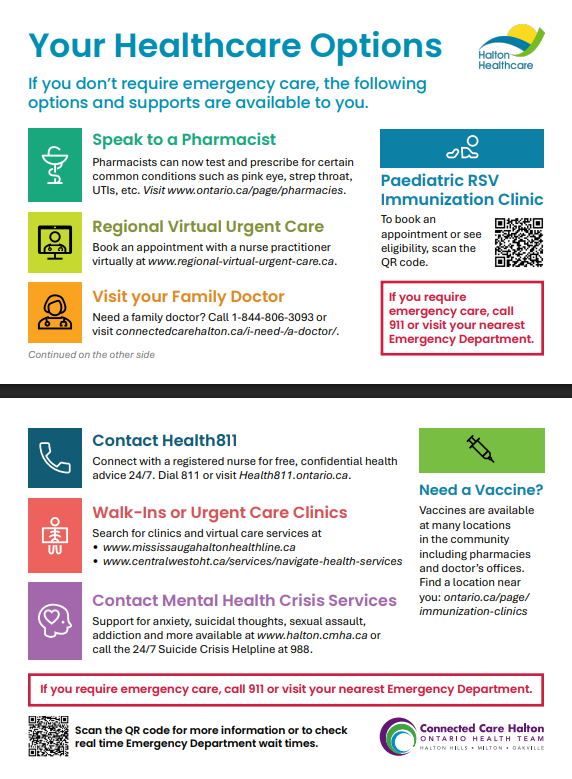
Your Community Healthcare Options
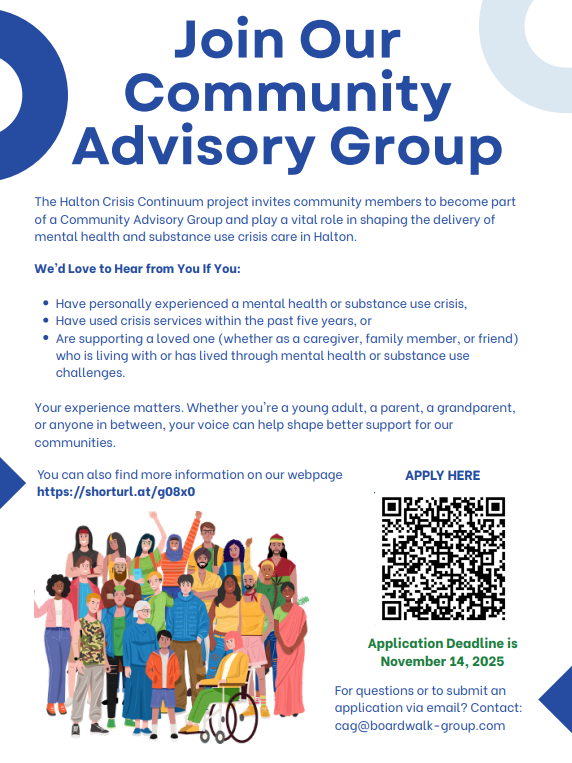
Now Recruiting: Halton Crisis Continuum Community Advisory Group
Now Recruiting: Halton Crisis Continuum Community Advisory Group
The Halton Crisis Continuum (HCC) brings together community, health, and social service partners across Halton Region to strengthen how mental health and substance use crisis supports are delivered — ensuring people get the right care, at the right time, from the right person.
We’re now inviting community members to join a new Community Advisory Group (CAG) that will help guide this work.
As a CAG member, you’ll:
✔️ Share your experiences and insights about crisis supports and services
✔️ Participate in discussions that shape how care is delivered
✔️ Join a supportive, inclusive, and accessible space for community voice
Who can apply:
People with lived or living experience of a mental health or substance use crisis, caregivers, family members, or friends who have supported someone through crisis. We especially welcome applications from people who identify as Indigenous, Black, racialized, disabled, neurodivergent, 2SLGBTQIA+, unhoused or precariously housed, first-generation immigrants, youth, and older adults.
Applications open October 27 and close November 14, 2025.
- Apply online or request a paper/phone application: https://forms.office.com/r/8t1cYGkcVL
- Questions? Check out our FAQ on our webpage https://shorturl.at/g08x0 or contact cag@boardwalk-group.com
2026-27 Interprofessional Primary Team Expansion — Proposal Details
2026–2027 Interprofessional Primary Care Team Expansion:
The Ontario government has announced a major investment in primary care, launching the 2026–2027 call for proposals to create and expand approximately 75 new primary care teams. This initiative aims to connect 500,000 more Ontarians to primary care as part of the province’s $2.1 billion Primary Care Action Plan, with the goal of ensuring everyone in Ontario has access to primary care by 2029
Summary Themes from our Operating Plan Engagement Sessions
October 1st 2025
A message from our Executive Director: Thank you to everyone who joined our engagement
sessions in August and September. Nearly 100 participants shared valuable input on what the
CCHOHT’s operational priorities for this year should be.
As promised, we are sharing with you in this summary document what we heard.
What’s next?: The CCHOHT team will host a town hall on Friday, October 3rd 2025, from 12–1pm to
present the summary and answer questions and share how you can stay involved in joining
working groups. Please continue to reach us through info@cchoht.ca
Thank you again!
Zoë Dawe, Executive Director CCHOHT and Dr. Kris Martiniuk Clinical Lead, Primary Care
Advancement
Meet the Support House Mobile Team!
Katharine – Equity and Access
The Support House Mobile Health Team removes barriers by meeting people where they are – making healthcare and supports easier to access in our community.
Interdisciplinary Care in Community
With a diverse interdisciplinary team, the Mobile Health Team supports the whole person, from counselling and peer support to primary care, delivering integrated services in community spaces to reduce barriers and meet people where they are.
For more information about the Support House Mobile Health Team: https://supporthouse.ca/chc/
AI Scribe Provincial VOR – Frequently Asked Questions
Dear Halton Physicians,
We are writing to provide an update and reminder about the Ontario AI Scribe Program. This initiative, led by OntarioMD and Supply Ontario, has completed its vendor of record (VOR) list for AI scribes.
Key Benefits of the Ontario AI Scribe Program
- Preferential pricing contracts
- Additional protection from liability (privacy & security)
- Support in selecting the right AI scribe for your needs
- Pre- and post-onboarding support
While EMR integration was not a requirement for inclusion on the list (to ensure physician needs—not EMR vendor priorities—drove the selection process), many vendors do offer integration.
You can submit an expression of interest here:
👉 OntarioMD AI Scribe Program
Canada Health Infoway Program
Separately, Canada Health Infoway offered 10,000 free one-year licenses for nine AI scribes (all but one of which also appear on Ontario’s list). While these licenses have already been distributed, physicians with an active license can still switch vendors within 3 months of their initial selection.
For comparisons:
- Features Comparison Matrix and EMR Integration Matrix are available here (select “view all” when asked to choose your region): Infoway AI Scribe Program
About Heidi
Many have asked why Heidi was excluded from Ontario’s VOR list. While the reason remains unclear, we have been told it is not related to being a non-Canadian vendor. Heidi remains a popular option, though in our evaluations some AI scribes have outperformed it in certain areas.
It is important to note that the VOR list will be refreshed within the next 12 months, so excluded vendors such as Heidi may be added in the future.
Our Local Evaluation
We are currently evaluating several AI scribes in clinical practice, focusing on:
- Speed of note generation
- Customization options
- Note quality & sophistication
- Extra features (e.g., billing codes, referral letters, adaptive learning)
Because each tool requires repeated patient visits to evaluate, a full review of all vendors will take time. In the meantime, we encourage you to trial an AI scribe directly—most vendors provide free trials.
Practical Tips
- Microphone quality matters. Built-in mics often underperform when voices move around the room. For best results, consider an external condenser microphone on a stand.
- Check transcripts. If they are clean and free of errors or nonsensical speech, your setup is likely adequate.
Bottom Line
An effective AI scribe should be intuitive, reliable, accurate, and efficient—reducing administrative burden while keeping costs manageable. The Ontario AI Scribe Program can help you identify the right solution, with the added reassurance of security and privacy protections.
We will share further updates in the coming months as our local evaluations progress.
Sincerely,
Dr. Kris Martiniuk
CCHOHT Clinical Lead, PCN Development
Dr. Yasar Razvi
CCHOHT Clinical Lead, Digital Projects

Connected Care Ontario Health Team: Our Operational Plan Impact 2024-2025
New mobile health van will pave health pathways to meet people where they are at.
Support House’s Community Health Centre’s Mobile Health Team was developed in collaboration with Connected Care Halton Ontario Health Team (CCH OHT), Halton Physicians Association, Oak Park/Churchill Neighbourhood Centre, the Mental Health + Addictions Alliance, and people with lived experience, including family and caregivers.
Funding has been provided through the province’s Interprofessional Primary Care Team (IPCT) to expand and enhance vulnerable populations’ access to primary care across Halton. That funding was recently extended through April 2027.
The CHC breaks down barriers to healthcare through a comprehensive team that includes 0.5 FTE Physician, 3 Nurse Practitioners, 2 Registered Nurses, 1 Social Worker, 1 Peer Support Worker, 1 Clinic Coordinator, and 1 Manager. Services include primary care, preventative care, harm reduction, chronic disease management, peer support, mental health care, addictions medicine, and addressing social determinants of health needs.
The mobile health van allows the Support House team to reach clients at encampments, local shelters, the Churchill Neighbourhood Centre, the Acton Youth Hub and other community partner sites across north and south Halton Region.
“This van allows us to continue to expand and enhance access to primary care,” says Christina Jabalee, Senior Director of Community Health at Support House. “This includes offering primary care in non-traditional forms to create alternate care pathways for people who face multiple barriers in accessing care including those that are unhoused, lack a current health card, and have multiple health concerns including mental illness and substance use. We know this mobile team can improve people’s health outcomes and our overall community wellness.”
Community Health: Meeting People Where They’re At
Improving primary care services to vulnerable populations was identified as a community need and is community-driven. Halton Public Health reports that one in 10 Halton adults (18-64) have been diagnosed with a mood and/or anxiety disorder, and from 2006 to 2015, the rate of ER visits for mental illness increased by 24%, with the rate of hospitalizations increased by 36%.
The CHC provides mobile care for life transitions and urgent needs, same-day service for primary care and mental health, and clinician connection within 2-3 days. Since launching in September, the program has served over 500 clients.
“The CHC is a great example of people coming together as one team to ensure the quality of care and quality of life for those often most at risk,” says Paul Gregory, Executive Director of Support House. “For those who are vulnerable and underserved, whose issues are often not given the attention needed, the CHC is helping to remove the barriers to accessing care by meeting people where they are in the community.”
The CHC is working closely with Support House’s Response Team, which has successfully addressed many social determinants of health and successfully housed people living in encampments and shelters who also face concerns with their mental health and substance use. The Response Team obtains referrals through the Region of Halton’s By-Name database, which prioritizes services for the unhoused/homeless population based on the highest acuity/need.
A local strategy for more connected health
The CHC aligns with the Ontario Government’s Your Health: A Plan for Connected and Convenient Care strategy, which includes a commitment to connect more people to primary care by creating interprofessional primary care teams to make access to care more convenient for those with the greatest need. These interprofessional primary care teams will provide direct care to vulnerable and marginalized people who struggle to access or lack a family doctor. This will help connect people to care without having to visit emergency rooms and experience long wait times.
This approach includes identifying barriers to people accessing their primary care provider, attending appointments with the client and primary care provider, and facilitating virtual appointments, among other strategies.
The Primary Care EOI submission was embraced by the CCH OHT and worked on through a highly collaborative and multidisciplinary group, including the Halton Physicians Association, The Mental Health + Addictions Alliance, Oak Park/Churchill Neighbourhood Centre, Halton Region and people with lived and living experience including family and caregivers. The proposal was supported by many physicians, specialists and Family Health Teams across the Region of Halton.
“The CHC program is a true expression of a community coming together to identify a need and working collaboratively to address it,” Gregory added. “This interprofessional project brings together health professionals who have not traditionally worked together, enhances care for an underserved population, and builds strong relationships.”
Referrals are accepted from community partners, primary care providers, specialists, ERs, and other acute care services. The referral process emphasizes a “no wrong door” approach and does not require a physician’s referral.
About Support House
Support House (supporthouse.ca) has provided support services and housing for people with mental health, substance use and addiction concerns in Halton since 1984. Support House provides low-barrier, harm-reduction approaches to providing accommodation and support to people with multiple needs to address housing stability issues.
Everyone deserves and has a right to housing.
FOR MORE INFORMATION CONTACT:
Paul Gregory, Executive Director, Support House
1-833-845-9355 ext 134
paulg@supporthouse.ca
Funding provided by the Government of Ontario
Halton Healthcare expanding palliative care service to Georgetown
The Georgetown Hospital is receiving a service upgrade, as Halton Healthcare is expanding its Outpatient Palliative Care Clinics.
This decision will bring compassionate, end-of-life care closer to home and ensuring patients and their families can access vital support and comfort in their own community.
“Palliative care offers relief, reassurance and guidance for both patients and their families, helping them navigate complex health journeys with greater confidence and peace of mind,” says Dr. Tarek Kazem, Palliative Medicine Division Lead, Halton Healthcare. “Building on the success of our clinics in Oakville and Milton, this new location will ensure that individuals living with serious health conditions or complex symptoms can access expert support, symptom management, and comfort in a setting that’s familiar and convenient.”
The Georgetown clinic will be led by Dr. Sumeet Khanna, a respected and experienced palliative care physician. With his leadership, patients will benefit from timely, coordinated outpatient care that reduces the need for travel during already difficult times. Until now, patients in the Georgetown area accessed this specialized care in Oakville or Milton.
“Expanding outpatient palliative care to Georgetown Hospital is an important step in strengthening how we deliver care across the region,” adds Dr. Khanna. “We’re not only improving access but also easing the burden on patients during some of the most challenging times in their lives. Our goal is to provide care that is timely, equitable, and deeply compassionate – designed to meet the unique needs of each patient.”
This expansion means that outpatient palliative care services are now available at all three Halton Healthcare sites – improving access, convenience and choice for patients and families across the region.
Milton District Laboratory – Outpatient Bloodwork – Letter for Community Physicians
To Our Community Physicians,
We would like to inform our community providers that Milton District Hospital Laboratory provides outpatient bloodwork services only for patients referred by physicians with hospital privileges at Halton Healthcare. This policy aligns with standard practices across hospitals in Ontario.
Requests that fall outside of this policy will be declined and redirected to community laboratories. If the request or situation is considered urgent, the patients should be directed to the nearest Emergency Department.
Most lab tests ordered by community physicians are covered by the Ontario Health Insurance Plan (OHIP) and can be completed at community laboratory service providers at no cost to patients. Additionally, community labs typically offer free parking.
Please visit the Halton Healthcare website at www.haltonhealthcare.on.ca for information on our outpatient laboratory service hours and locations. For some community laboratory service locations, please visit www.lifelabs.com, www.dynacare.ca or www.cmlhealthcare.com.
We kindly ask that this notice be shared within your clinic(s). On behalf of the Laboratory Management Team, thank you for your cooperation and support in aligning with our hospital policy. We appreciate your attention to this matter.
Regards,
Dr. Nadeen Edmondson, Medical Director and Chief Pathologist, Laboratory
Shairoz Kherani, Director Diagnostic Imaging & Laboratory Services
Shubhra Mohan, Laboratory Manager for Milton District Hospital and Georgetown Hospital